Greenhouse gas accounting has a reputation for being harder than it is. For a company with one site and a handful of vans, the whole exercise is a few numbers off bills you already receive.
The three scopes, briefly
Scope 1 - what you burn. Fuel combusted in things you own or control: gas in your boiler, diesel in your own vehicles, LPG in a forklift. If you bought the fuel and burned it, it is Scope 1.
Scope 2 - the electricity you buy. Emissions produced at a power station on your behalf. You did not burn anything, but the grid did.
Scope 3 - everything else. Purchased goods and services, business travel, commuting, waste, the use of what you sell. This is the large, awkward one, and for most SMEs it dwarfs the other two.
The data you actually need
For Scope 1 and 2 the input is activity data, not emissions:
- Cubic metres of natural gas, from your gas bills.
- Litres of diesel and petrol, from fuel cards or expense claims.
- Kilowatt-hours of electricity, from your electricity bills.
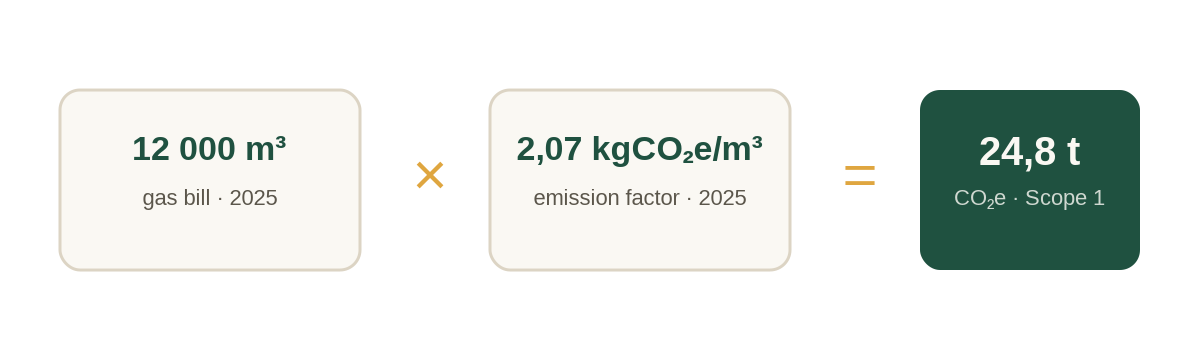
That is the collection job. Converting activity data into tonnes of CO₂ equivalent is a lookup against a published emission factor - kg CO₂e per cubic metre of gas, per litre of diesel, per kWh of grid electricity in your country. You should never be typing a tCO₂e figure in by hand; you type in the litres and let the factor do the arithmetic.
Two things that trip people up
Location-based versus market-based electricity. Location-based uses the average carbon intensity of your national grid. Market-based uses the specific contract you signed - a certified renewable tariff gives a much lower, sometimes zero, market-based figure. These are two different numbers for the same kilowatt-hours and both are legitimate; the mistake is reporting one and labelling it the other. If you are on a green tariff, report both and say which is which.
Picking the wrong year's factor. Grid intensity changes measurably year on year as generation mixes shift. A 2026 report using 2019 grid factors will overstate your electricity emissions, often by a lot. Match the factor year to the reporting year.
About Scope 3
Full Scope 3 accounting across all fifteen categories is a genuine project, and it is not what a customer asking for VSME data usually needs. Start with the categories where you have real data - business travel from expense reports, waste from your contractor's collection notes, purchased goods from spend data. Report those, state your boundary explicitly, and say what you excluded.
A narrow, honest Scope 3 figure with a stated boundary is worth more to the person reading your report than a wide one built on guesses. It is also the one you can defend when they ask where the number came from.
Sources
This post is general information, not legal advice. Rules and official materials change - always check the current text at the official source.