A reduction target is the one line in a sustainability report that people remember. "We will cut emissions 42% by 2030" is quotable in a way that "our Scope 2 was 118 tonnes" is not. That is exactly why it should be set carefully: you will be measured against it every year.
Four decisions, in order
1. A base year. The year your reduction is counted from. Pick the earliest year for which you have a complete, defensible Scope 1 and 2 figure - not the earliest year you can estimate. If your first proper report is for 2025, your base year is 2025. Reaching back to 2019 with reconstructed numbers gives you a target nobody can audit.
2. A target year. Five to ten years out is the usual range. Shorter than five and the target is really just a budget; longer than ten and nobody in the company today will be there to answer for it. 2030 has become the default because so many customer commitments land there.
3. Absolute or intensity. An absolute target is tonnes: 100 tCO₂e in the base year, 58 in the target year. An intensity target is tonnes per something
- per million euros of revenue, per employee, per unit produced. Intensity targets survive growth; absolute targets are what customers and banks increasingly ask for, because they are the ones that add up at the planet's level. If you expect to double in size, set an intensity target and say so. If not, set an absolute one.
4. The number. The widely used benchmark for a target consistent with limiting warming to 1.5°C is a linear reduction of about 4.2% of base-year emissions per year, which works out to roughly 42% over ten years. You do not have to adopt that figure, but if you pick something smaller, expect to be asked why.
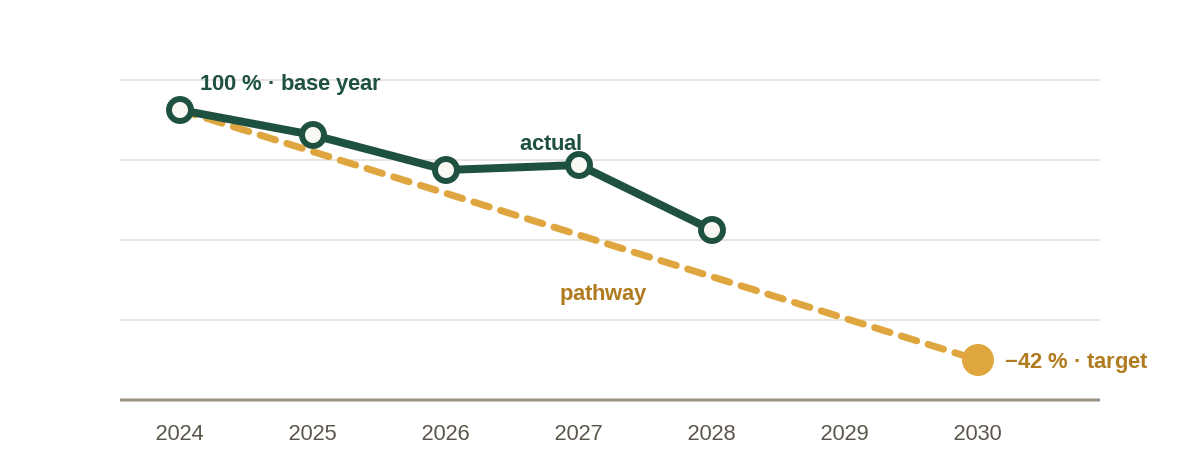
The pathway is the useful part
A target is two points. The pathway is the line between them, and it is what turns a promise into something you can manage. With a 2025 base of 100 tonnes and a 2030 target of 58, your 2027 figure should be about 83. If your 2027 report says 91, you know in early 2028 that you are eight tonnes behind, and which of the two remaining years has to absorb it.
VSME Hub draws this line for you: set the base year and target in the C3 disclosure, and each subsequent year's report plots its calculated Scope 1+2+3 total against the pathway. Years for which you have a real report are read from that report, so the chart cannot drift from the numbers you actually published.
Scope 3, and whether to include it
Most SME targets cover Scope 1 and 2 only, and that is a reasonable place to start. Scope 3 is usually the largest share of a company's footprint, but it is also the share you control least directly, and a target that depends on your suppliers' behaviour is one you cannot promise to hit.
The honest structure is: a firm Scope 1+2 target with a pathway, and a separate, stated intention for the Scope 3 categories where you have real data - business travel, waste, the goods you buy in bulk. State the boundary of your target explicitly. "Scope 1 and 2, market-based" is a target. "Our emissions" is a question.
What to do when you miss
You will, in some year. Grid factors change, a cold winter adds gas, a new site comes online. Use the narrative next to the target for exactly this: say what happened, what you changed, and whether the target year still holds. A missed milestone with an explanation reads as a company that is managing its emissions. A pathway chart with a quietly re-based year reads as the opposite.
Sources
This post is general information, not legal advice. Rules and official materials change - always check the current text at the official source.